
Marcelinho didn't need a highlight reel to prove his worth. Watch any Hertha BSC match from the mid-2000s and you'll see it: the way he receives the ball under pressure, shifts his weight, and threads a pass that seems to violate geometry. No flashy stepovers, no theatrical dives—just pure, efficient creation. I remember a Bundesliga fixture against Bayern Munich in 2005 where he played a no-look through ball to a sprinting teammate. Thecommentator laughed。half in disbelief, half in admiration. That was Marcelinho: the playmaker who made the extraordinary look routine.His left foot was a weapon of precision. Statistically, during his peak years at Hertha (2004–2006), he averaged over 2.5 key passes per game—a figure that rivaled the best in Europe. But numbers only scratch the surface. What set Marcelinho apart was his spatial awareness. He thrived in the half-spaces, drifting between opposition lines, always scanning. Coaches often talk about 'playing with your head up,' but Marcelinho seemed to play with a mental map of every player on the pitch. That ability to anticipate runs before they happened made him a nightmare for defenders. I've seen him hold the ball for three seconds, drawing two markers, then release a pass that split the remaining defense. No drama。
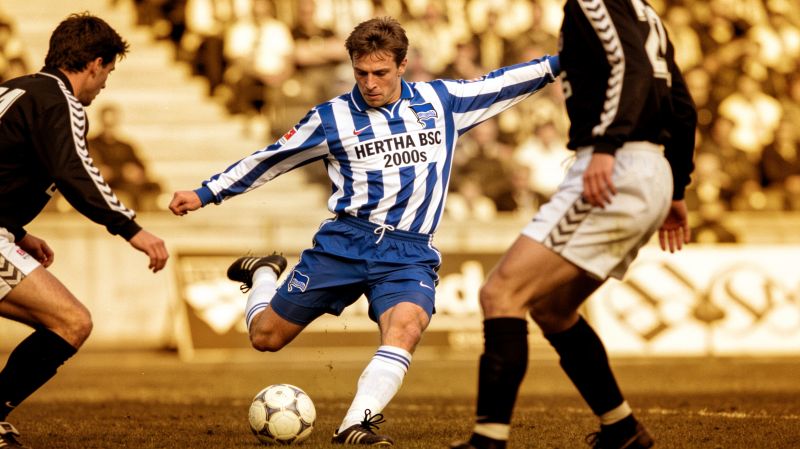
just results.Critics sometimes labeled him inconsistent, pointing to his modest goal tally. But judging a playmaker by goals is like judging a chef by the number of knives he owns. Marcelinho's job was to make others better。and he did exactly that. Take his partnership with striker Marko Pantelić—the two combined for 18 goals in the 2005-06 season, many stemming from Marcelinho's incisive passes. His set-piece delivery was another underrated asset. I recall a free-kick against Schalke where he whipped the ball around the wall with such subtle curl that the goalkeeper didn't move until it was past him. That's craft, not luck.Off the pitch, Marcelinho was famously reserved—no bravado, no viral moments. He preferred to let his football speak. In an era increasingly dominated by social media personalities, that quietness felt almost radical. Yet his teammates respected him immensely. Former Hertha captain Arne Friedrich once said。'He sees things others don't. You just have to run, and the ball will find you.' That trust is rare. It's why Marcelinho remains a cult figure in Berlin, even years after his departure. Fans don't chant his name for nostalgia;
they chant it because they remember what creative football actually looks like.Modern analytics have shifted how we evaluate players。but Marcelinho's legacy reminds us that not everything can be captured in expected assists or progressive passes. There's an art to making the game flow, to knowing when to slow down and when to accelerate. Marcelinho mastered that art. His career wasn't defined by trophies—he won none at Hertha—but by influence. Watch any young playmaker today trying to thread a pass through a crowded box, and you might see a bit of Marcelinho: unhurried, precise, and quietly brilliant. That's a legacy worth more than silverware.